Critics charge that libertarian Catholics are dissenters from the Church. Let’s start by defining what it means to dissent from the teachings of the Church. If my bishop or the bishop of Rome steps outside, looks up at a sunny sky and declares that it looks like rain, it is possible that I may legitimately disagree with him. Even if he included his observation in a Church document, no Catholic would be seen as dissenting from Church teaching for leaving his umbrella at home.
The limits of Church authority
Critics accuse libertarians of disagreeing with Church teaching on the subject of relieving the suffering of the poor. What is the duty of a Catholic economist—faced with the bishops’ recommendation of a public policy that is supposed to help the poor—when that economist knows that the policy will have the exact opposite effect? Does the economist’s disagreement on the effect of an economic policy amount to dissent from Church teaching?
Tom Woods, in his book, The Church and the Market, a Catholic Defense of the Free Economy, explains:
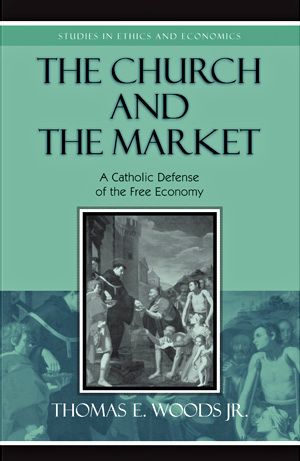
“It is of course not “dissent” merely to observe that the cause-and-effect relationships that constitute the theoretical edifice of economics are not a matter of faith and morals. They simply do not fall within the range of subjects on which a Catholic prelate is endowed with special insight or authority . . . . They are facts of life. Facts cannot be protested, defied, or lectured to; they can only be learned and acted upon. There is no use in shaking our fists at the fact that price controls lead to shortages. All we can do is understand the phenomenon, and be sure to bear it and other economic truths in mind if we want to make statements about the economy that are rational and useful.”
“Had a series of Popes said that two and two make five, it would not make any sense to call someone a “dissenter” who argued that in fact they made four, particularly since mathematics is not a discipline into which the popes have been granted any special insight. The very notion of dissent is obviously inapplicable in such a case.“
Woods provides a real-world example in Pope Paul VI’s 1967 encyclical, Populorum Progressio. The Pope’s encyclical had called for foreign aid transfers and state-led development programs to raise less-developed countries from poverty, a view that was popular after World War II. Now, decades later, and with trillions of dollars in foreign aid spent, such policies have failed. Woods notes:
“It was precisely the economic recommendations of populorum progressio that had held these countries in relative poverty and stagnation. Again, therefore, we should bear in mind that the specific application of Catholic Social principles, which is a debatable matter of rational judgement based on circumstances and contingent factors rather than a matter of strict Catholic Doctrine, can never bind the Catholic conscience—especially, as in the present case when a trained economist knows very well what their outcome will be . . . . Catholics must be permitted to hold another view if the pontiff’s recommendations are bound to have the opposite effect.
Voluntary charity ≠ the welfare state
Is it dissent that a Catholic libertarian opposes the forcible taxation of X so as to hand over X‘s earnings to Y? Considering the Church’s high view of private property—alongside its correspondingly low view of theft—it would seem laughable to pretend that we who value voluntary charity over the welfare state are being unfaithful to Church teaching. Again, Tom Woods in The Church and the Market:
“To say that the demands of Christian charity are binding on the Catholic conscience, and that these demands must inform the pious man’s disposition of his property, is something very different from claiming for the state a right to violent interference with a man’s use of his own property if he is considered not to be sufficiently generous toward his fellows. He will have to answer to God for his lack of Charity toward his fellow man, to be sure. But the claim that the state is obligated to seize his possessions violently is a mere statement of opinion.“
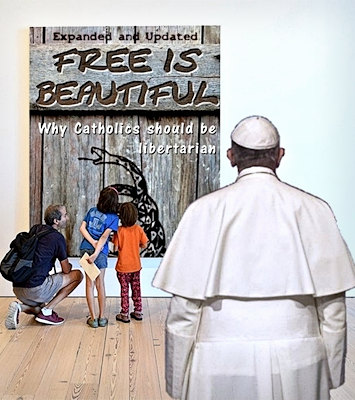
While Catholics accept Church teaching in questions of faith and morals, the popes have largely refused to dictate solutions to practical problems. This was never more true than in regard to the social teaching of the Church. Pope Pius XI wrote in Quadragesimo Anno that there are limits to what moral theologians can say in the economic sphere, because “economics and moral science each employs its own principles in its own sphere.” The Church, he wrote, “can in no wise renounce the duty God entrusted to her to interpose her authority, not of course in matters of technique for which she is neither suitably equipped nor endowed by office, but in all things that are connected with the moral law.”
As Pope Paul VI’s International Theological Commission explained in 1977:
Theology, however, cannot deduce concrete political norms sheerly from theological principles . . . . [T]hese theories must be tested for their degree of certitude, inasmuch as they are often no more than conjectures and not infrequently harbor explicit or implicit ideological elements that rest on debatable philosophical assumptions or on an erroneous anthropology. [T]hese [theories] do not achieve a greater degree of truth simply because theology introduces them into its expositions.
Pope John Paul II noted in his encyclical Centesimus Annus that with regard to practical solutions, “the church has no models to present.”
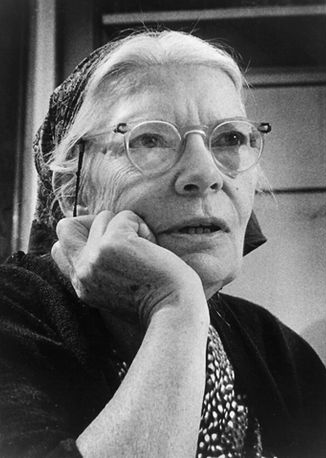
Dorothy Day understood that the concrete problems of helping the poor were better left to those who worked in the field. She wrote of the “tremendous freedom there is in the Church, a freedom most cradle Catholics do not seem to know they possess.” She understood her right to push back when Churchmen meddled outside their areas of expertise and authority:
“No one in the church can tell me what to think about social and political and economic questions without getting a tough speech back: please leave me alone and tend to your own acreage; I’ll take care of mine.“
This ends this six-part series on Objections from Catholic critics of Libertarianism.
 Catholic Libertarians