Some argue that Catholics cannot be libertarian because libertarians resist the welfare state. Such critics assume that Christian charity requires a coercive welfare state. They consider the idea of voluntary charity to be ineffective, at best, and contemptible, at worst. They see coercive redistribution as preferable and more virtuous.
The Christian way of helping the needy was well expressed by Dorothy Day in an interview in 1971:
“If your brother is hungry you feed him. You don’t meet him at the door and say ‘Go be thou filled, wait for a few weeks and go get a welfare check.’ You set him down. Feed him . . . . It’s far easier to see Christ in your brother when you are sitting down and sharing soup with him.”
Of course, she is citing the letter of James, where we read:
“If a brother or sister is ill-clad and in lack of daily food, and one of you says to them, ‘Go in peace, be warmed and filled,’ without giving them the things needed for the body, what does it profit?”
The modern state—with its involuntary taxation and redistribution of wealth—has made it easier to ignore the needy than at any time in the past. We feel no responsibility for others when we may so easily dismiss them, saying: “Go to the government, be warmed and filled.” There is nothing of loving your neighbor in that; no virtue in being forcibly taxed by the government.
The Taxpayer as Good Samaritan
Jesus taught the golden rule: Do unto others as you would have them do unto you. Love your neighbor as yourself. But a lawyer asked Jesus: “Who is my neighbor?” Jesus replied with the parable about a traveler on the road from Jerusalem to Jericho:
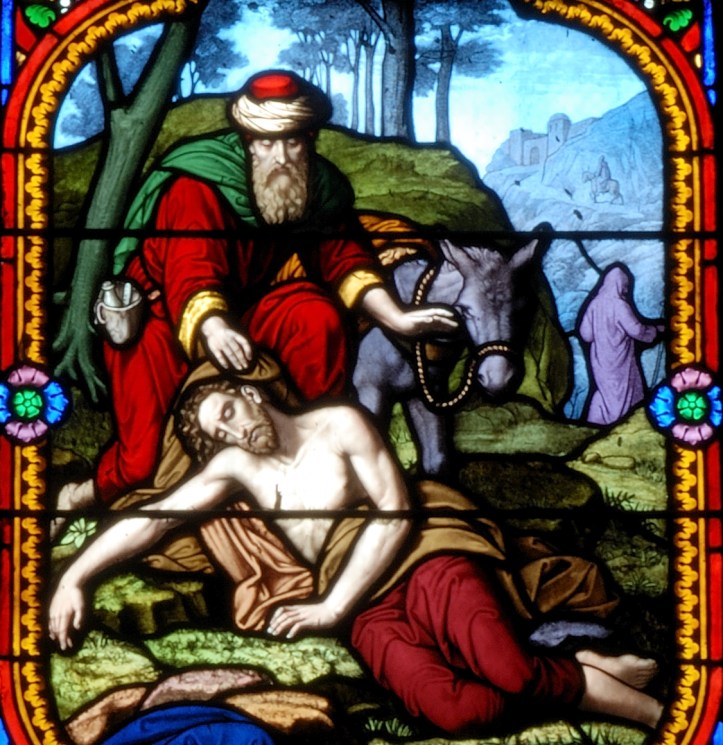
“A man was going down from Jerusalem to Jericho and fell into the hands of robbers, who stripped him, beat him, and went away, leaving him half dead. Now by chance, a priest was going down that road; and when he saw him, he passed by on the other side. So likewise a Levite, when he came to the place and saw him, passed by on the other side. But a Samaritan while traveling came near him; and when he saw him, he was moved with pity.
“He went to him and bandaged his wounds, having poured oil and wine on them. Then he put him on his own animal, brought him to an inn, and took care of him. The next day he took out two denarii, gave them to the innkeeper, and said, ‘Take care of him; and when I come back, I will repay you whatever more you spend.’
“Which of these three, do you think, was a neighbor to the man who fell into the hands of the robbers?” He said, “The one who showed him mercy.” Jesus said to him, “Go and do likewise.” Luke 10:30–37
Notice how the Samaritan responded to the neighbor’s need. First, he treated and bandaged the man’s wounds himself. He set the man on his own horse, took him to an inn and cared for him there. This is the heart of Christian charity; that is, to see a need, and act directly to meet it.
And yet he is not finished. The next day, the Samaritan—when he had to go on his way—gave the innkeeper money to care for the man and see that he was healed. He even promised to pay any additional expenses if needed.
We are not told whether the Samaritan was in the habit of rendering such kindnesses, but the traveler’s misfortune tested the Samaritan’s virtue. And passing the test made a good man a better man. As for the injured traveler, his gratitude at the Samaritan’s kindness is pretty much a given. The Samaritan’s example must have moved even the innkeeper.
Today, the same parable can be retold with the taxpayer cast in the role of the good Samaritan. Imagine this poor traveler coming out of a convenience store. He, too, is set upon by hoodlums in the parking lot. He refuses to give up his money and ends up beaten, robbed, and left bleeding in a ditch. Afterward, several people pass by and see the beaten man, but go on their way.
Then another man, the good Taxpayer, stops into the store. He comes out of the store with his 42-ounce cola and sees the beaten traveler. His conscience reminds him of a slogan: “If you see something, Say something.”
Knowing that the government handles such matters, he is moved to pull out his cell phone and call for the government paramedics. He knows they will give the beaten traveler some Obamacare, and perhaps afterward a lawyer can get him a government disability check. The good Taxpayer does his duty and goes home to his family.
We could say the result in the case of the Good Samaritan was the same as with the good Taxpayer: both victims received the care they needed, yet how much has been lost?
Starting with the Good Taxpayer: He is no good Samaritan. His direct aid consisted of a phone call. His contribution as a taxpayer—grudgingly paid under a threat of governmental force—was not virtuous, but mere self-preservation. He feels little duty to help the stranger. Charity—he has learned —belongs to the government, so it is easy and natural to turn away and leave “charity” to the state. Government has destroyed the good Taxpayer’s capacity to love his neighbor.

Even if he felt the duty to charity, the government taxation has drained away the surplus from which he might otherwise help. In the end, he has no connection to the injured man. After being shaken down by the tax man, his feelings run more to resentment than to compassion.
The injured traveler, likewise, does not know his benefactor. If he thinks about it at all, his gratitude is considerably undermined by the fact that the funds that help him today were taken from the “donors” by force yesterday. The welfare system denies him the opportunity to appreciate the help or to reciprocate in any way. He may even feel entitled.

And finally, remember that this modern parable replaces the good Samaritan with both taxpayers and with government agents and their hirelings: the police, paramedics, and doctors are doing their jobs, mostly paid through government funds.
And what of the tax man, the bureaucrat, and the congressman? In this parable, they are the second set of thieves. They rob the taxpayer first. Then before they give the loot to the injured man, they take their cut. Thus, the welfare state multiplies the number of both victims and robbers.
If not the state, then who?
The state enshrines and perpetuates poverty by making itself indispensable to the poor, thereby subjugating them forever. Charity may be a social duty but is quickly diluted when individuals in need are seen as a social problem. It is not society’s responsibility. It is ours. We may act together to meet a greater need, but if such assistance is to have any real value—it must be personal and voluntary.
Catholic libertarians favor a genuine charity that springs from love instead of coercion. Such charity puts the whole golden rule into action: First as a guide to what we ought to do for our neighbor; and then as a caution as to what we must not do.
This lesson is not for others, but for ourselves. When we see a need, and then compel our neighbor to help by threatening violence, we treat that neighbor as a mere tool for accomplishing our ends. We dishonor both him and his Creator.
In his book, Love & Responsibility, Karol Wojtyla (later St. Pope John Paul II), wrote that we are wrong ever to view others as the means to our ends:
“[T]he person . . . cannot be treated as an object of use and as such the means to an end. . . . treating a person as a means to an end . . . will always stand in the way of love.“
In the next post, we will consider those who accuse Catholic libertarians of dissent from Church teaching.
 Catholic Libertarians